Yonta Labs runs a Solana validator on its own hardware, its own ASN, and its own IP space. Not a rented slice of somebody else's cloud, and connected over DoubleZero rather than shared public transit. Operating continuously since October 2023.
Loading live validator data
Live network status
Everything below is fetched from Stakewiz when this page loads. We do not type these in, and we cannot edit them. If a number here is bad, you will see it before we do.
Loading every Solana validator's location
DoubleZero publishes no publicly queryable list of its points of presence, so this map plots validator locations only. Our DoubleZero connectivity is described above rather than drawn here, because drawing it would mean guessing.
Checking whether our stake sits above the halt line.
Track record
Live since October 2023. We do not take any native stake commission, and never have. We run Jito for MEV, which carries a separate 10% MEV commission. We state that plainly rather than advertise "no fees" and let you find it yourself.
We run over DoubleZero, the dedicated network layer built for validators. It moves consensus traffic off the shared public internet and onto private fiber, which cuts jitter and removes a whole class of dependency on transit providers we do not control.
Jito-Solana client with MEV enabled, so delegators receive a share of MEV rewards on top of inflation rewards. MEV commission is 10%. Native stake commission remains 0%.
Part of Marinade Stake Select, the curated set introduced in 2025 that routes stake on operational quality rather than on bids.
We participate in several Solana stake pools in addition to Marinade, which spreads delegation across independent sources rather than concentrating it in any single counterparty.
Vote credit ratio and skip rate are the two numbers that decide what a delegator actually earns. Ours are shown live at the top of this page, pulled from a third-party source rather than asserted by us.
Who runs it
Yonta Labs is a team of three with roughly 50 years of combined experience across network architecture, solutions architecture, application development, and finance, including work for Fortune 500 clients before any of us touched a validator.
We do not front the operation with personal brands. A validator should be judged on vote credits, skip rate, and how it behaves during a bad epoch, all of which are public and none of which improve because an operator has a following. The numbers at the top of this page are the pitch.
Owns the ASN, the IPv4 allocation, the routing, and the physical build. Decides what iron we buy and how it is connected.
Hands on the node: client upgrades, configuration, monitoring, and the response when an epoch goes sideways at an inconvenient hour.
Treasury, delegation relationships, and participation in the governance decisions that shape what operators are required to do next.
Continuous operation through client upgrades, network incidents, and every epoch in between. Long enough to have opinions, short enough to still be paying attention.
What we operate
Most validators are a virtual machine in a datacenter that also hosts a few hundred others. That is cheap, and it is fine right up until the moment the shared layer underneath moves and takes every tenant with it. We built the other way: bare metal we specified, in space we control, announced from AS19344, our own autonomous system number.
| Component | Typical validator | Yonta Labs |
|---|---|---|
| CPU | 12 cores / 24 threads, 2.8 GHz | AMD EPYC 9475F, 5th Gen, 48 cores / 96 threads |
| Memory | 256 GB | 768 GB DDR5 |
| Storage | NVMe SSD, 256 GB | 20 TB PCIe 5.0 Kioxia, 5 x 4 TB |
| Bandwidth | 1 Gbps symmetric | Dual 100 Gbps symmetric |
| Network identity | Rented address space, announced by the provider | Our own ASN (AS19344) and our own IPv4 allocation, announced by us |
| Transit | Shared public internet | DoubleZero private fiber |
The first four rows compare against Solana's published minimum hardware requirements. The last two compare against how validators are commonly deployed, since Solana publishes no network-identity requirement.
We hold our own ASN and our own IPv4 space, so our routes are originated by us rather than by a hosting provider. When an upstream misconfiguration propagates through a shared provider, every operator sitting inside that provider's address space goes dark together. Independent origination is the difference between being affected by someone else's outage and being responsible for your own.
Solana's published minimums describe a node that keeps up today. They do not describe one that keeps up through a load spike, a state-growth jump, or a client upgrade that changes the performance envelope. The spread between the two columns above is the margin we keep so a bad epoch stays boring.
Games
We build short games about how Solana actually works. Free, no install, no wallet, no signup. Opens in your browser and runs on a phone.
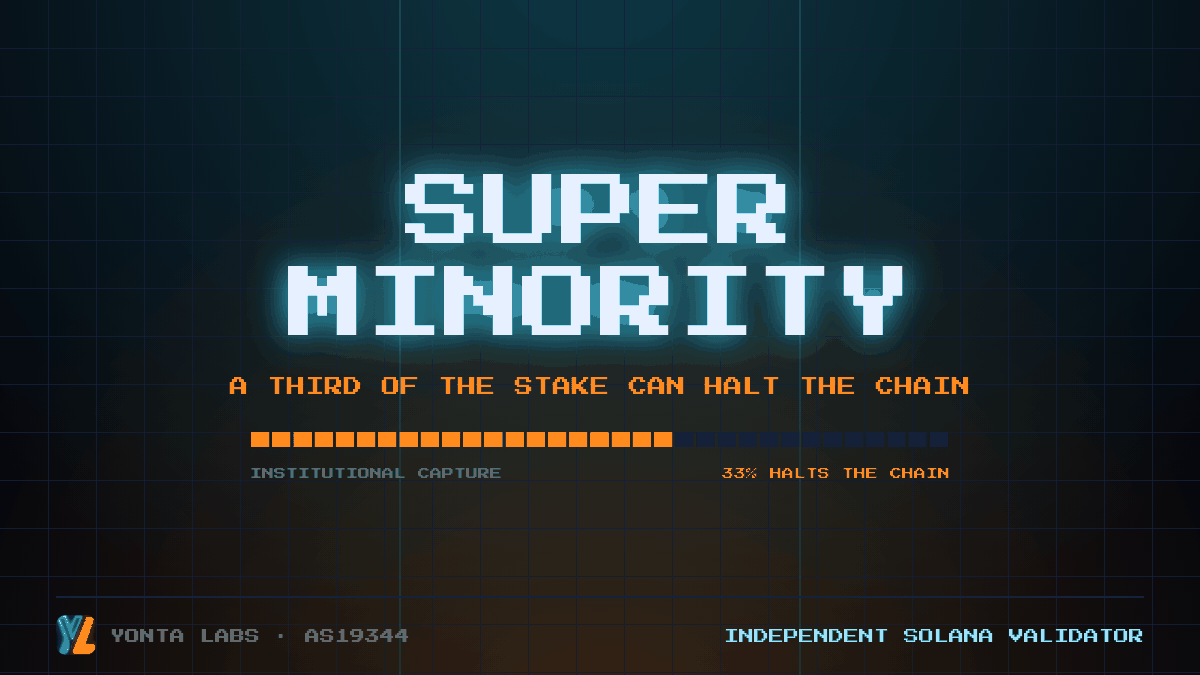
A third of the stake can halt the chain. Race the Nakamoto coefficient to 33 across five stages before institutional capture gets there first, dodging route leaks on the way.
PLAY NOW →Another operator problem, same format. In development.
COMING SOONCommunity
Questions about delegating, yontaSOL, or how we run the node are best asked directly. Telegram is where we are most active and where operational updates go first.
Day to day chat, updates, and the fastest way to reach us.
JOIN →Longer form discussion and support threads.
JOIN →Announcements, and where game runs get posted.
FOLLOW →Build photos and the occasional look at the hardware.
FOLLOW →We will never DM you first, and we will never ask for a seed phrase, a private key, or a wallet signature in chat. Anyone who does is not us.
Delegate
Delegating does not transfer custody. Your SOL stays in your wallet, you can undelegate at any time, and deactivation completes at the end of the epoch. Search for Yonta Labs in the staking tab of Solflare, Phantom, or Backpack, or paste the vote account below.
| Field | Value |
|---|---|
| Vote account | BeSov1og3sEYyH9JY3ap7QcQDvVX8f4sugfNPf9YLkcV |
| Native stake commission | 0% |
| MEV commission | 10% via Jito |
| ASN | AS19344 |
| Network | DoubleZero |
yontaSOL is our liquid staking token. You hold a token that accrues staking rewards instead of a locked stake account, so it stays usable across DeFi: lending, LPing, or trading, without unstaking first and without waiting out an epoch to exit. Find it on Sanctum or Jupiter.
| Field | Value |
|---|---|
| Token | yontaSOL |
| Type | Liquid staking token, stays usable in DeFi while it accrues rewards |
| Where to find it | Sanctum and Jupiter |
Confirm the mint address against the listing on Sanctum or Jupiter before swapping. Lookalike tickers are common on Solana.
Staking rewards are variable and are not guaranteed. Figures shown are third-party estimates based on recent epochs, not a promise of future yield. Nothing here is financial advice.